

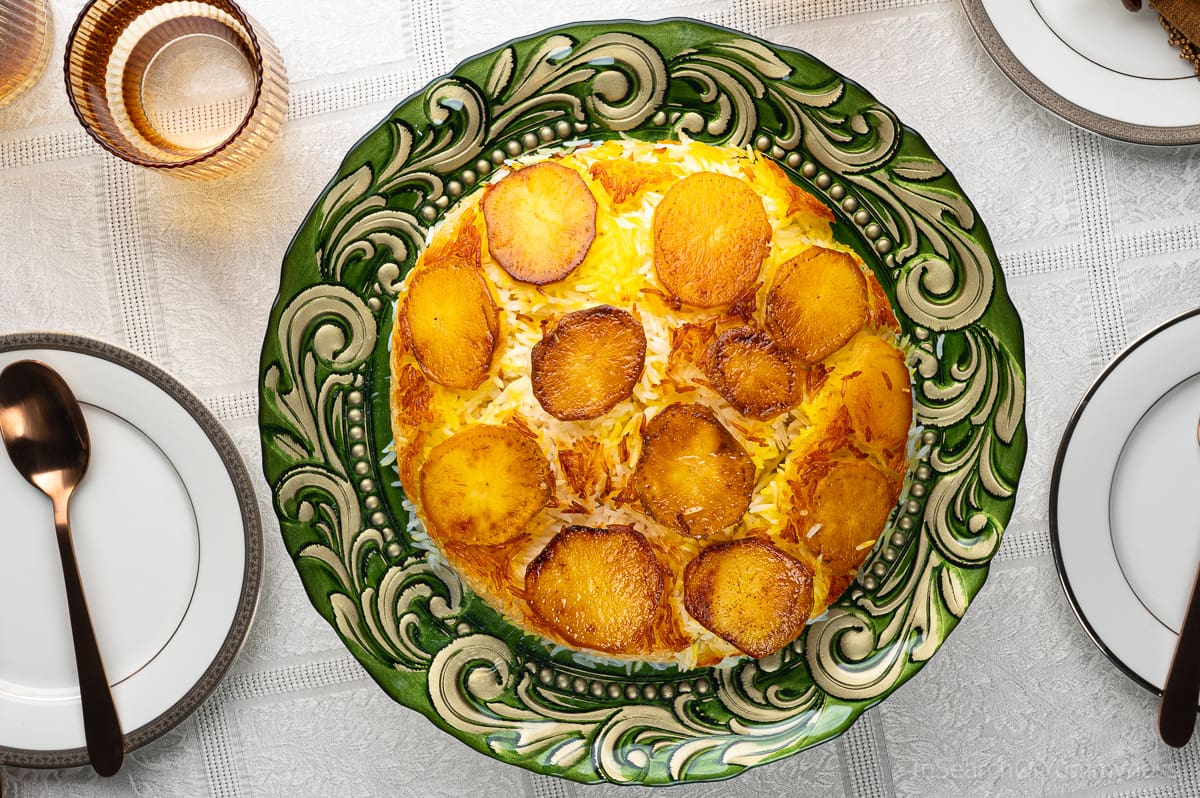
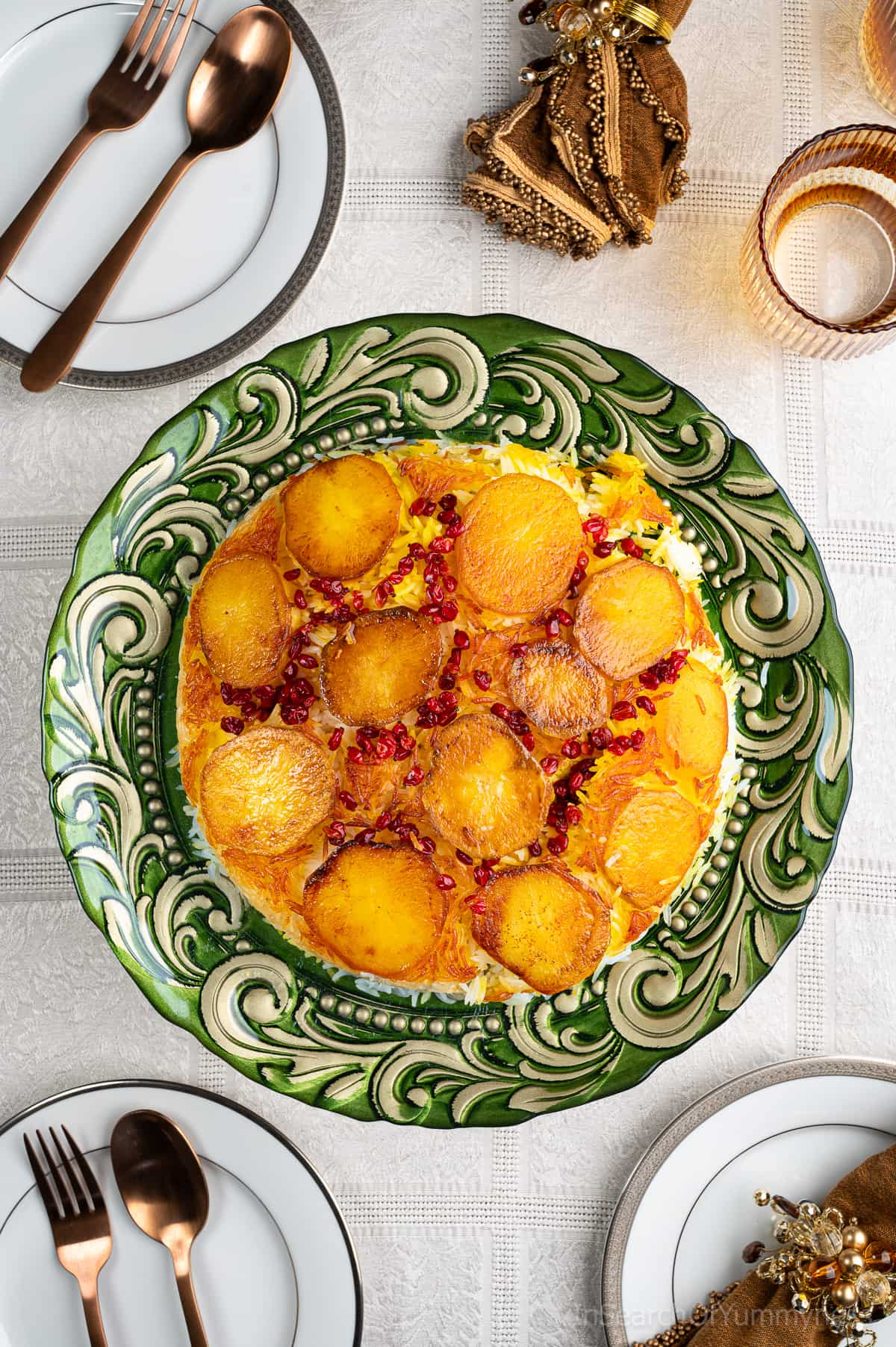
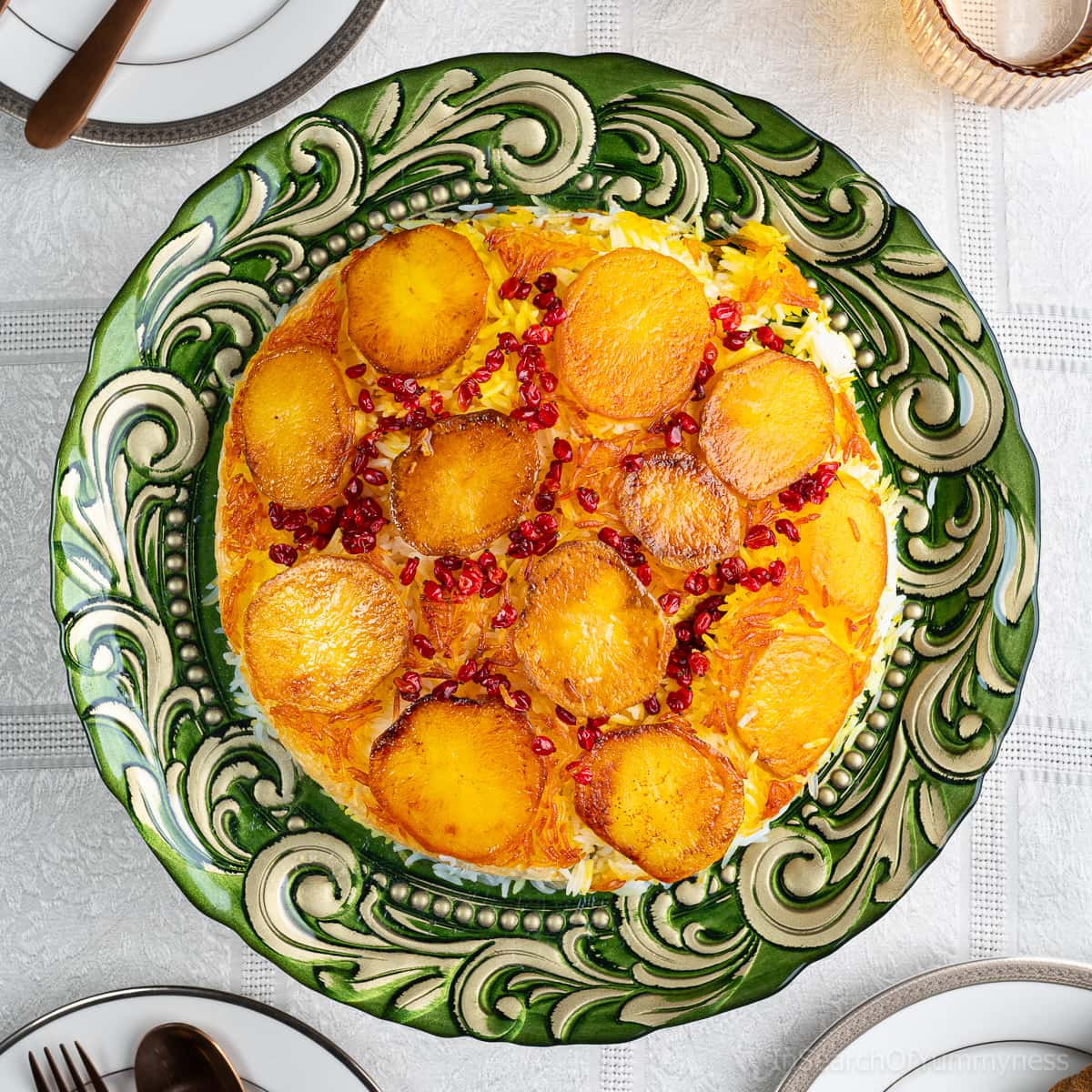
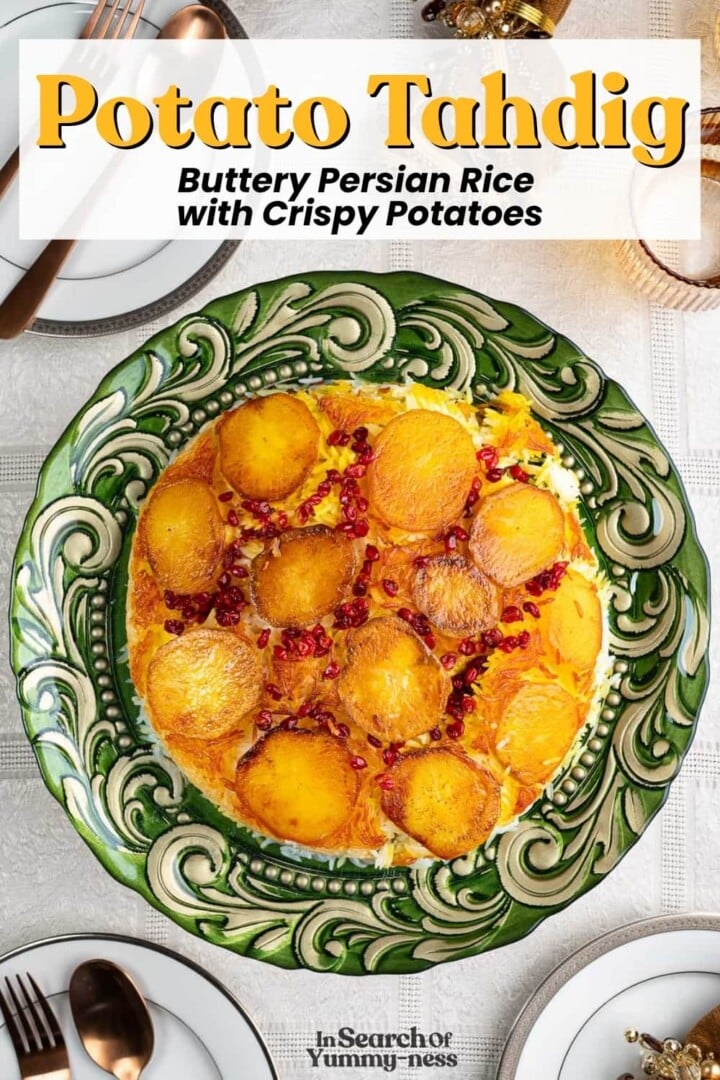
Potato Tahdig is a Persian rice dish with golden, crispy potatoes on the bottom and tender, buttery basmati rice on top.
The potato slices get crispy where they touch the pot but stay soft and fluffy inside, while the nutty, fragrant basmati rice is rich with butter and saffron (optional).
Tart barberries (also optional) add bright pops of tang and colour, making this recipe ideal for special occasions.
Recipe Highlights
- Servings:
- Time Commitment: 55 minutes (15 minutes of preparation and 40 minutes of cooking)
- Effort Required: Moderate. While the recipe isn't difficult, it may take a few tries to find the right heat setting for your stove.
- Special Equipment: A heavy non-stick saucepan with a snug-fitting lid and a clean tea towel. A pan with handles on both sides is easier to invert onto a plate, but I only had one with a long handle, and it still worked.
- Dietary Notes: Vegetarian. You can substitute oil for the butter.
I have tried it today and it was SO delicious! I thought it would be a lot of work but it's not and the dish is fantastic. The potatoes were crunchy and the rice so fluffy. Really good! - Martina ⭐️⭐️⭐️⭐️⭐️
Jump to:
What is Potato Tahdig
Tahdig is a Farsi word meaning "bottom of the pot." It refers to the golden, crispy layer that forms at the bottom of the pot, which can be rice, potatoes, or unleavened flatbread, depending on the version you make.
Potato Tahdig is the version made with sliced potatoes. You fry them in oil and butter at the bottom of the pot while the rice steams above, so when you flip the dish onto a plate, the crispy golden potatoes crown the rice for a beautiful presentation.
Ingredients and Substitutions
This potato tahdig recipe uses simple ingredients, but the rice and potatoes you choose make a difference.
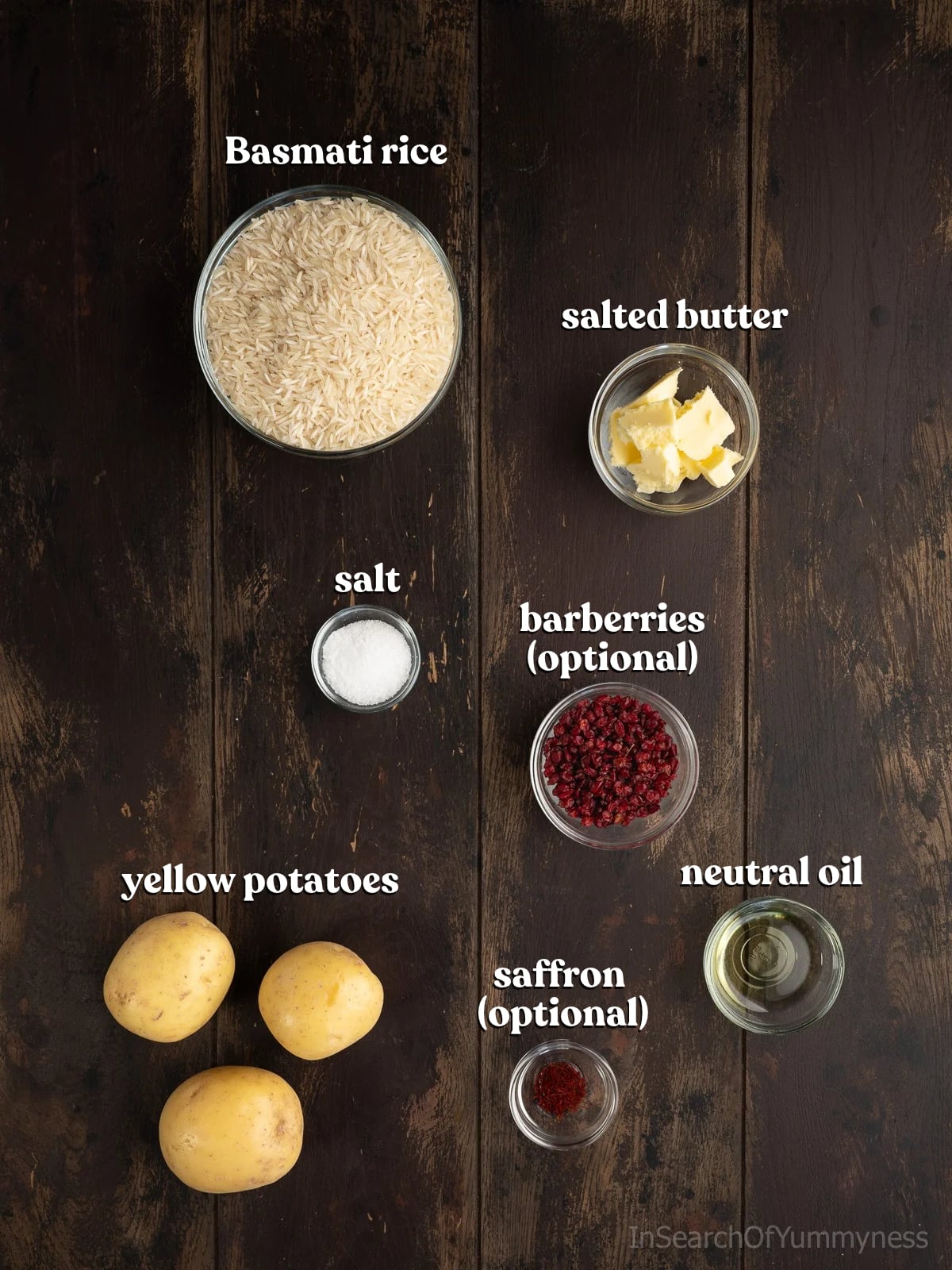
- Basmati Rice: A fragrant, long-grain rice with a nutty flavour. It's delicious all on its own, but really shines in this dish. Good-quality basmati rice should have no broken grains and a nice aroma even before cooking.
- Potatoes: Yukon Gold potatoes work really well, but they're becoming difficult to find. Any yellow or gold potato should work. Russets are another option.
- Butter and Oil: I use salted butter for flavour and grapeseed oil because it's neutral and has a high smoke point. The butter adds rich flavour, but you can omit it to make this recipe dairy-free (replace it with more oil).
- Saffron (optional): Saffron is expensive, but it adds lovely flavour and colour. A pinch of threads is all you need. If you're not familiar with this ingredient, I have an article about what saffron is and how to use it.
- Barberries (optional): These small, tart dried berries add tang and colour to the rice, but they're not essential to the finished dish.
This recipe has not been tested with all possible substitutions or variations. Making changes may alter the taste, texture, or overall outcome. If you try a different ingredient, please share in the comments!

See the recipe card for the complete ingredient list and recipe instructions.
Variations
- Without Potatoes: You can make this Persian rice recipe without potatoes; the rice will become crispy on the bottom instead.
- Sweetened Barberries: Some people warm the barberries through with butter, sugar and saffron to flavour them. I was taught to simply mix them with the saffron water, but this method helps balance their tart flavour if you prefer.
Why I Make This Recipe
This saffron-scented rice with crispy potatoes has been a staple in my life for so many years; I can't even remember the first time that I ate it.
All I know is that I was in grade school, because that's when my family, who had immigrated to Canada from Trinidad, met another family who had immigrated to Canada from Iran.
This family had children close to my age, and soon we went to each other's homes for dinner.
The adults would chat in the living room while we watched episodes of The Simpsons in the basement (which was exciting because my mom never let my brother and me watch that show at home).
For dinner, we often had the same meal: buttery white rice topped with crispy potatoes and Swiss Chalet chicken. I quickly fell in love with that rice dish and was always excited to see it on the table.
At the time, I didn't know that the dish was Persian rice with potato tahdig. I just affectionately called it Iranian rice for years. That rice dish showed up for every dinner we had together for decades.
Even when I turned 30-something, that family's dad brought over potato tahdig for my birthday. He knew I had had a rough year, and knew that this dish would cheer me up. It made me feel so special that someone went through all that trouble to make me something I enjoy.
After years of being fed this dish, I finally asked to learn how to make it. Luckily, two Iranian family friends were happy to share their recipes with me. They each have their own method for making this dish, and the version I'm sharing here combines the two recipes.
How to Make Potato Tahdig
While this recipe may look complicated, it's really very simple to make. The trickiest part is flipping it out of the pan and onto the plate.
If your tahdig breaks when you flip, don't be discouraged. You can push it back together with a spoon, and it will still taste delicious!
If you're using saffron and barberries, boil water in a pot or kettle before you start so you have hot water to soak the barberries; then let the water cool before adding it to your saffron.
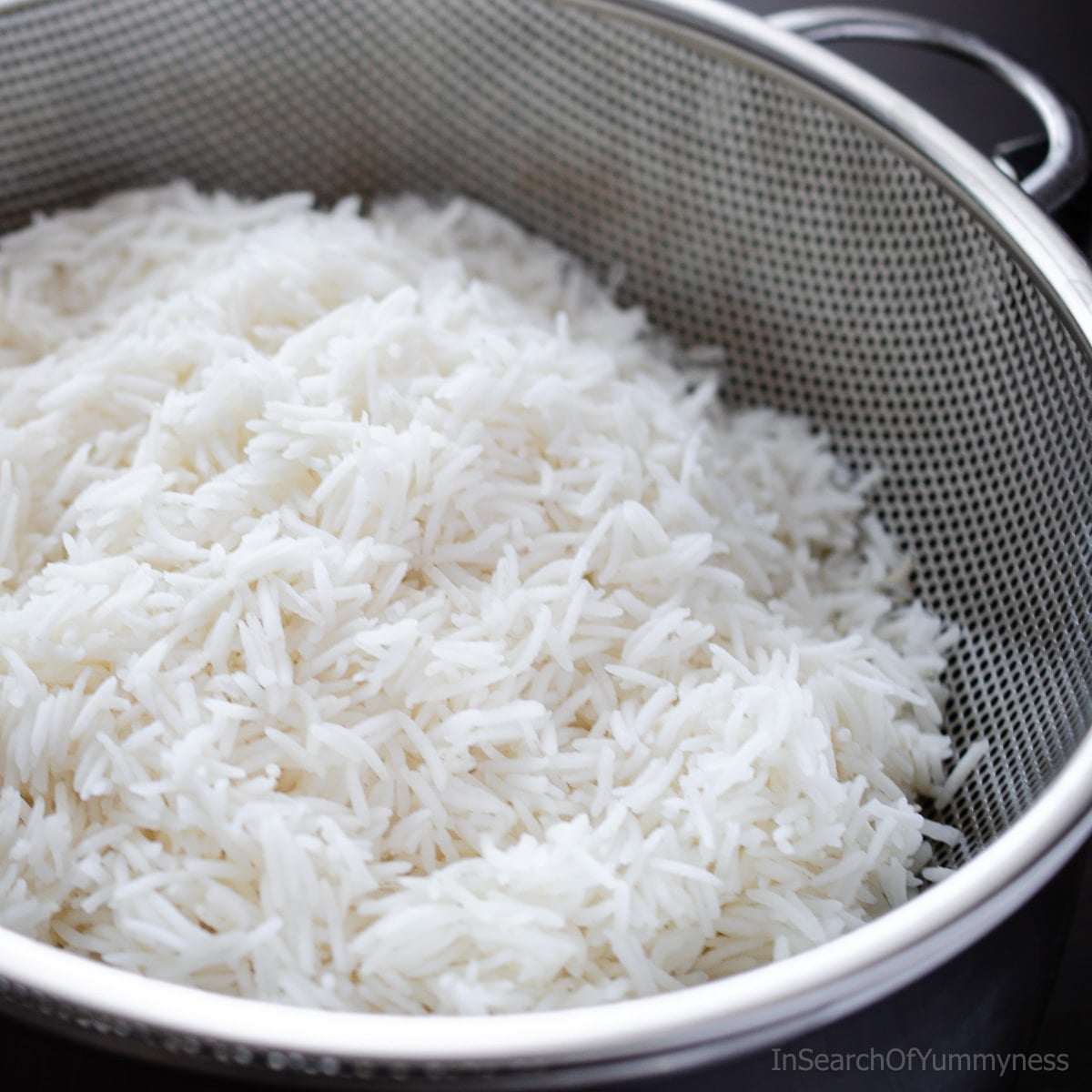
Step 1: Rinse the rice several times in a bowl, changing the cold water each time, until the water runs clear. Soak in cold water for 15 minutes, and drain. Bring a large pot of water to a boil and add 1 tablespoon of salt. Add the rice and cook for about 5 minutes, then drain. Rinse with cold water and drain again.
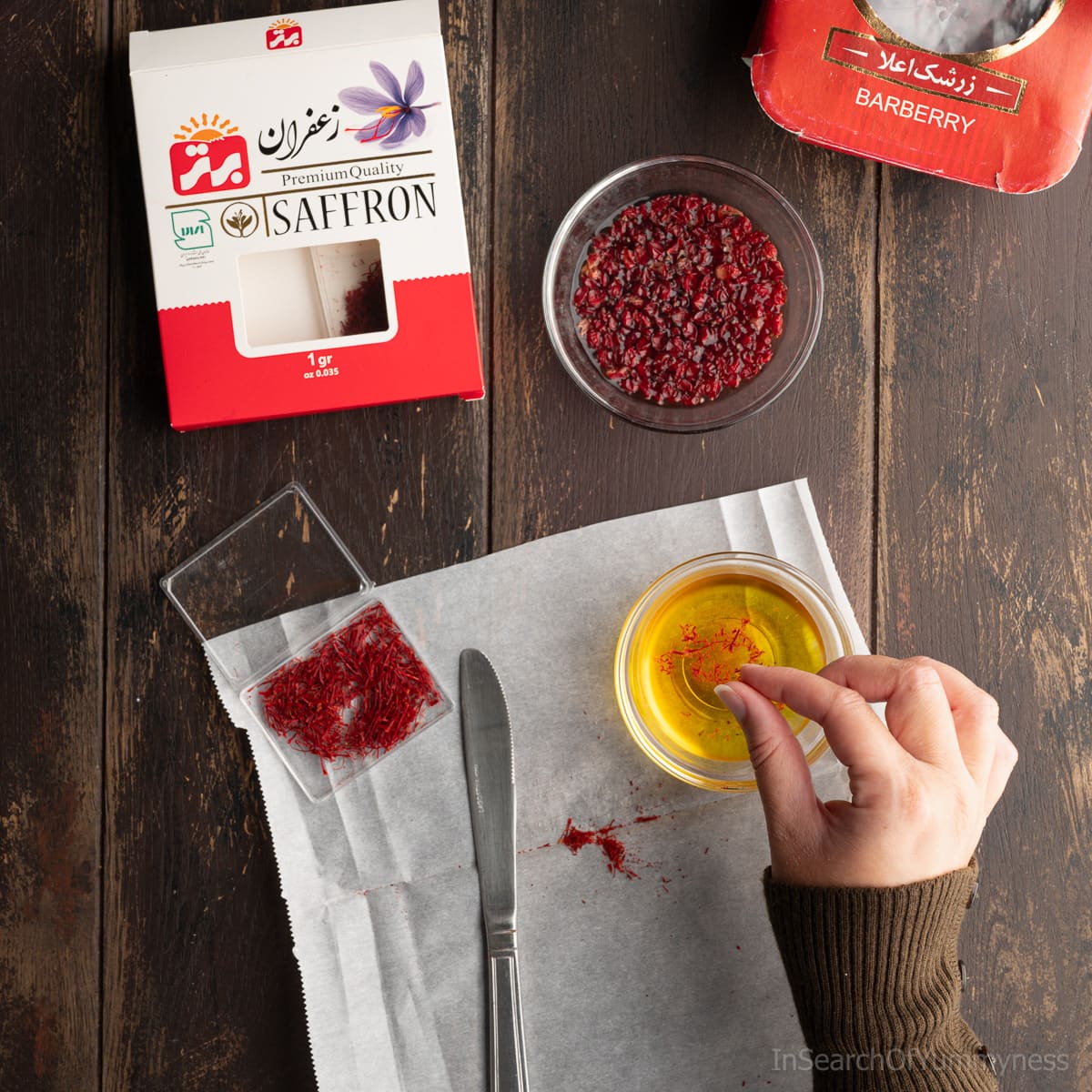
Step 2: If using saffron, place the threads in the center of a small piece of parchment paper, fold it into a sealed packet, and crush the threads by tapping firmly with the back of a table knife on a cutting board. Tip the saffron into a small bowl, stir in 3 tablespoons of hot water, and leave it to steep.
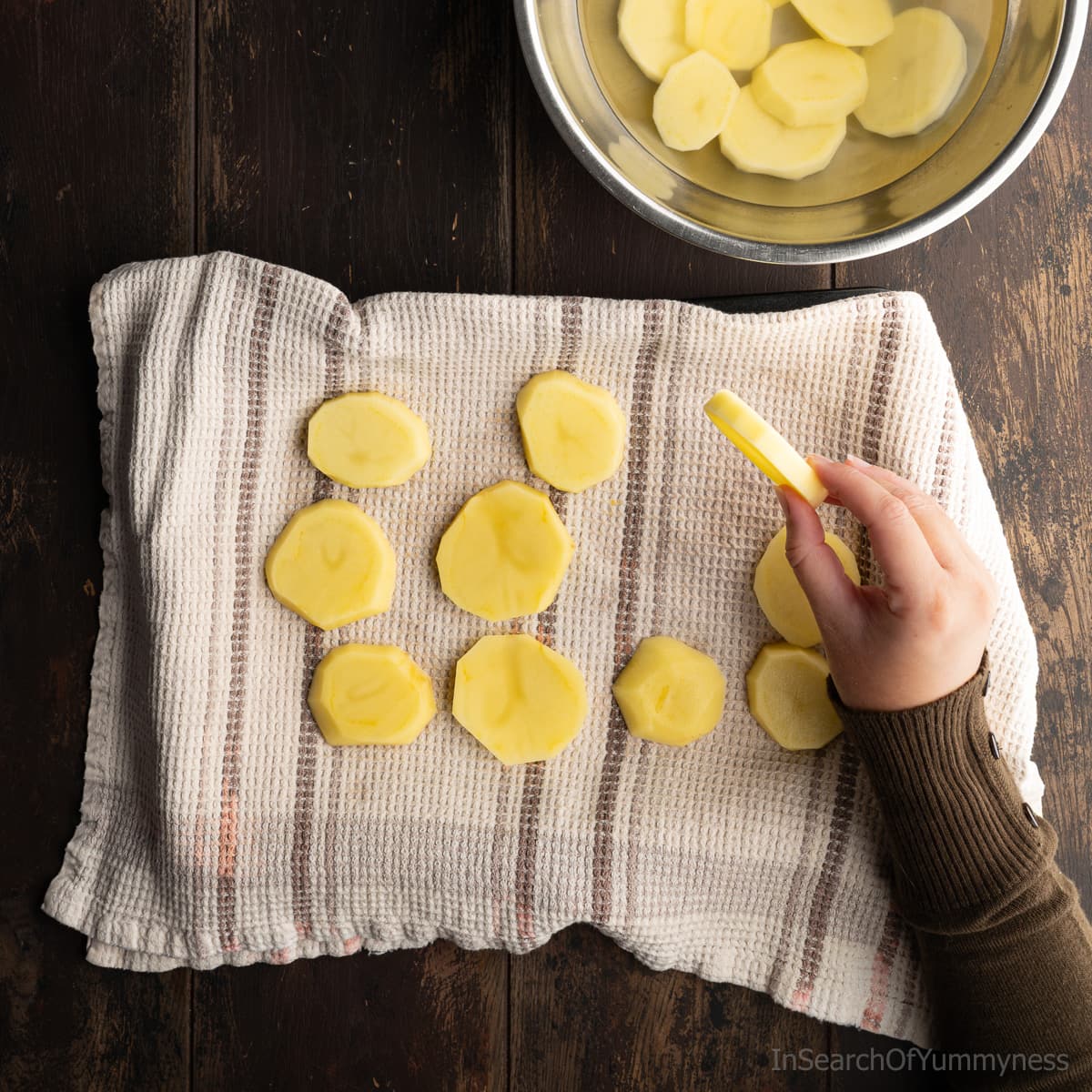
Step 3: Peel the potatoes, slice them into ¼-inch (about 6mm) rounds, and soak them in cold water. When you're ready to cook, drain the potatoes, rinse them with cold water, then drain completely. Pat dry with a clean kitchen towel or paper towels.
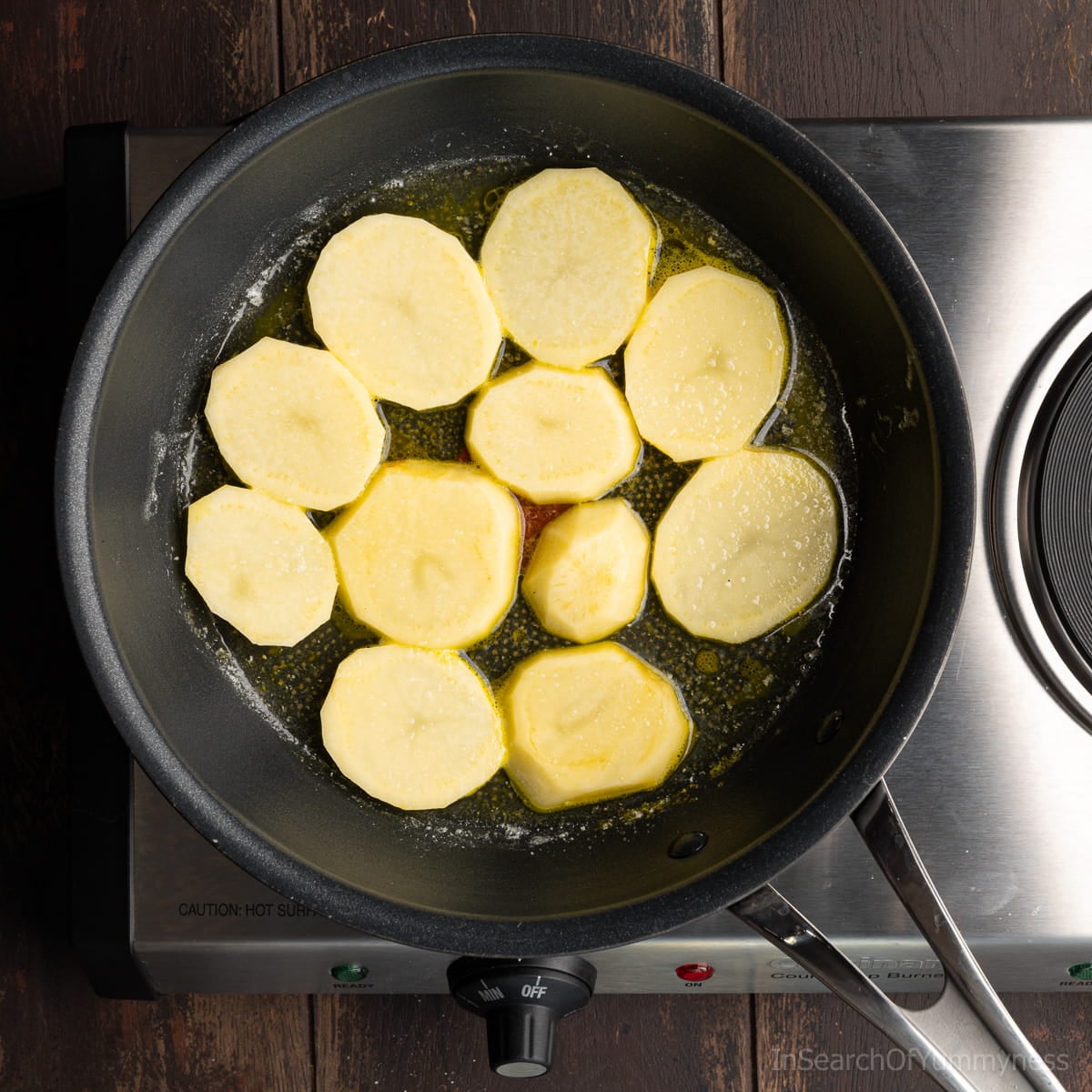
Step 4: Heat the oil and 1 tablespoon of butter in a non-stick pan over medium heat. When the butter melts, add 1 tablespoon of the saffron water (it may sputter, so be careful). Add the dry potatoes in a single flat layer and season with salt.
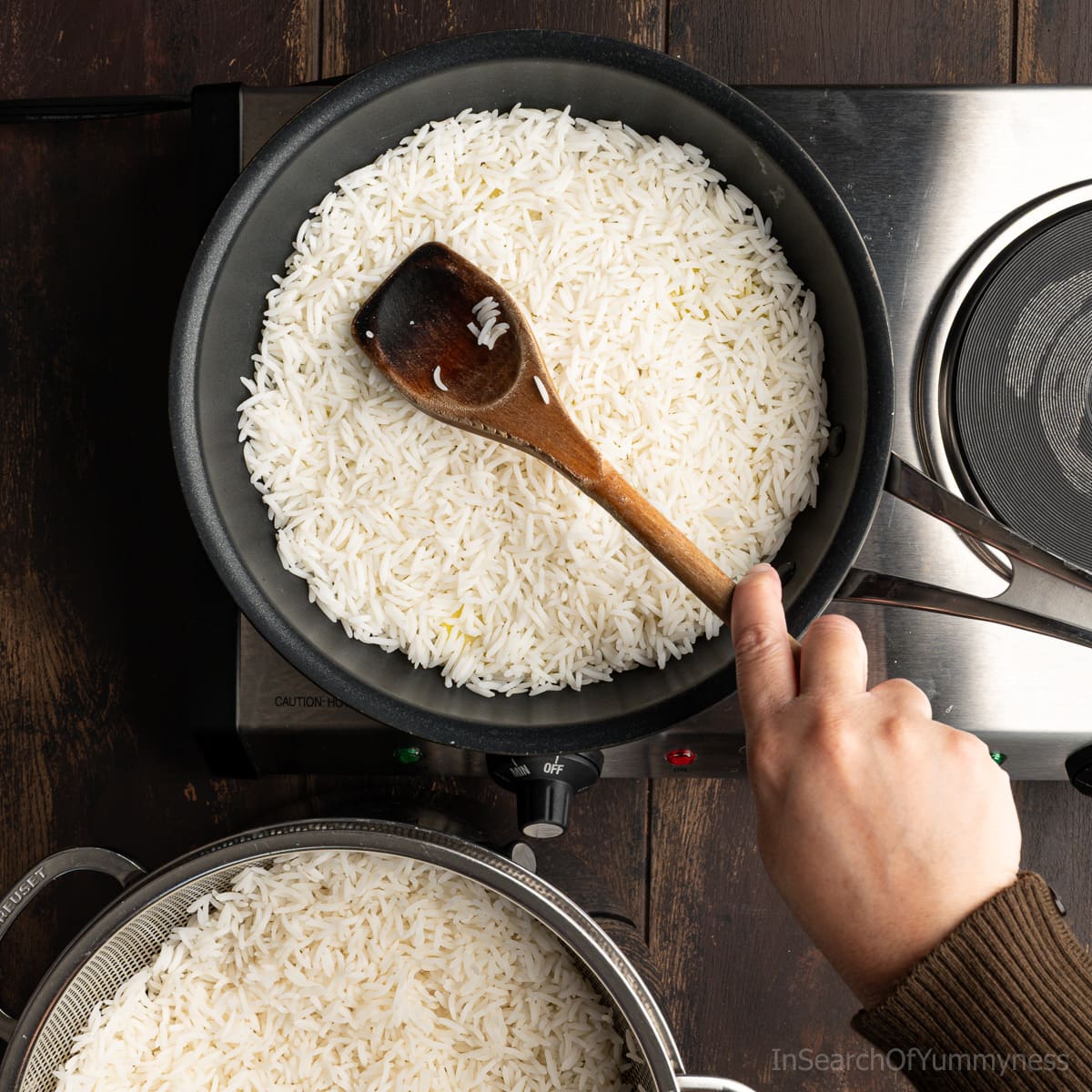
Step 5: Add a small, even layer of the partially cooked rice on top of the potatoes and press down firmly. This helps to create the crispy crust. Add the rest of the rice and gently press down.
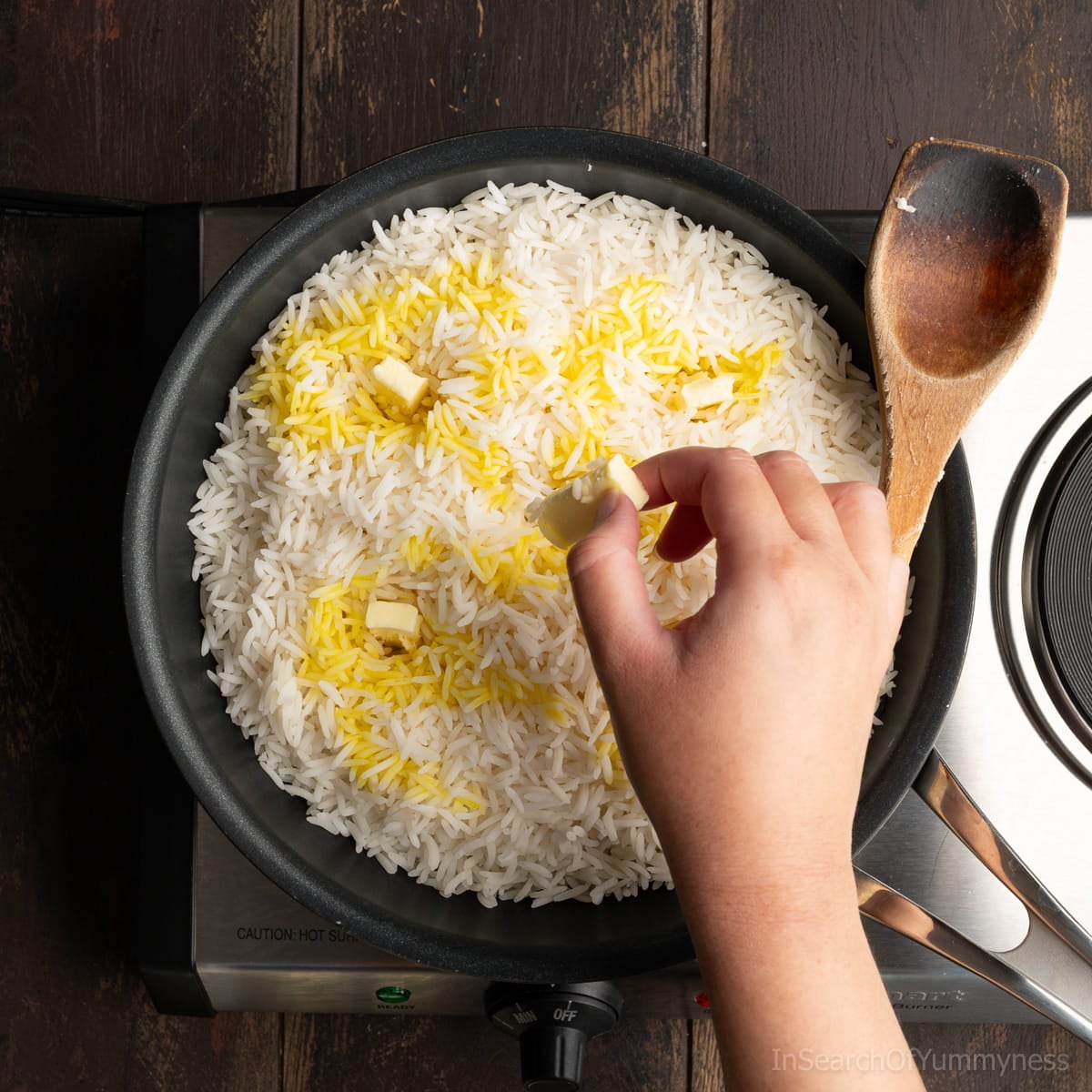
Step 6: Pour 1 tablespoon of the saffron water over the rice. Then poke 5 shallow holes in the rice, press in pats of the remaining butter, and smooth the top to cover the holes.
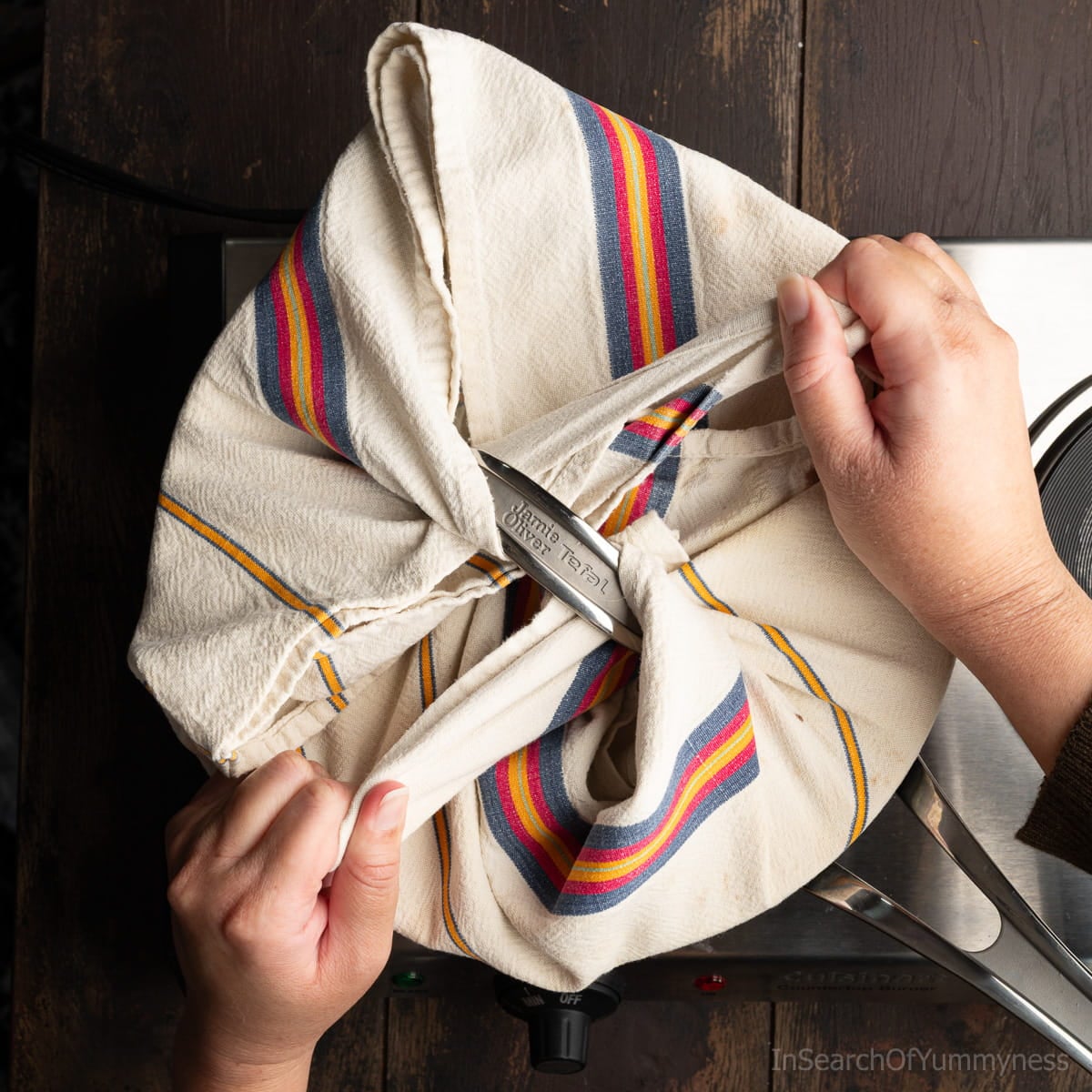
Step 7: Wrap a clean towel around the pan lid, tucking in the excess so it doesn't catch fire. Place the wrapped lid on the pan. Cook over medium heat for 5 minutes, then reduce to medium-low for about 20 minutes.
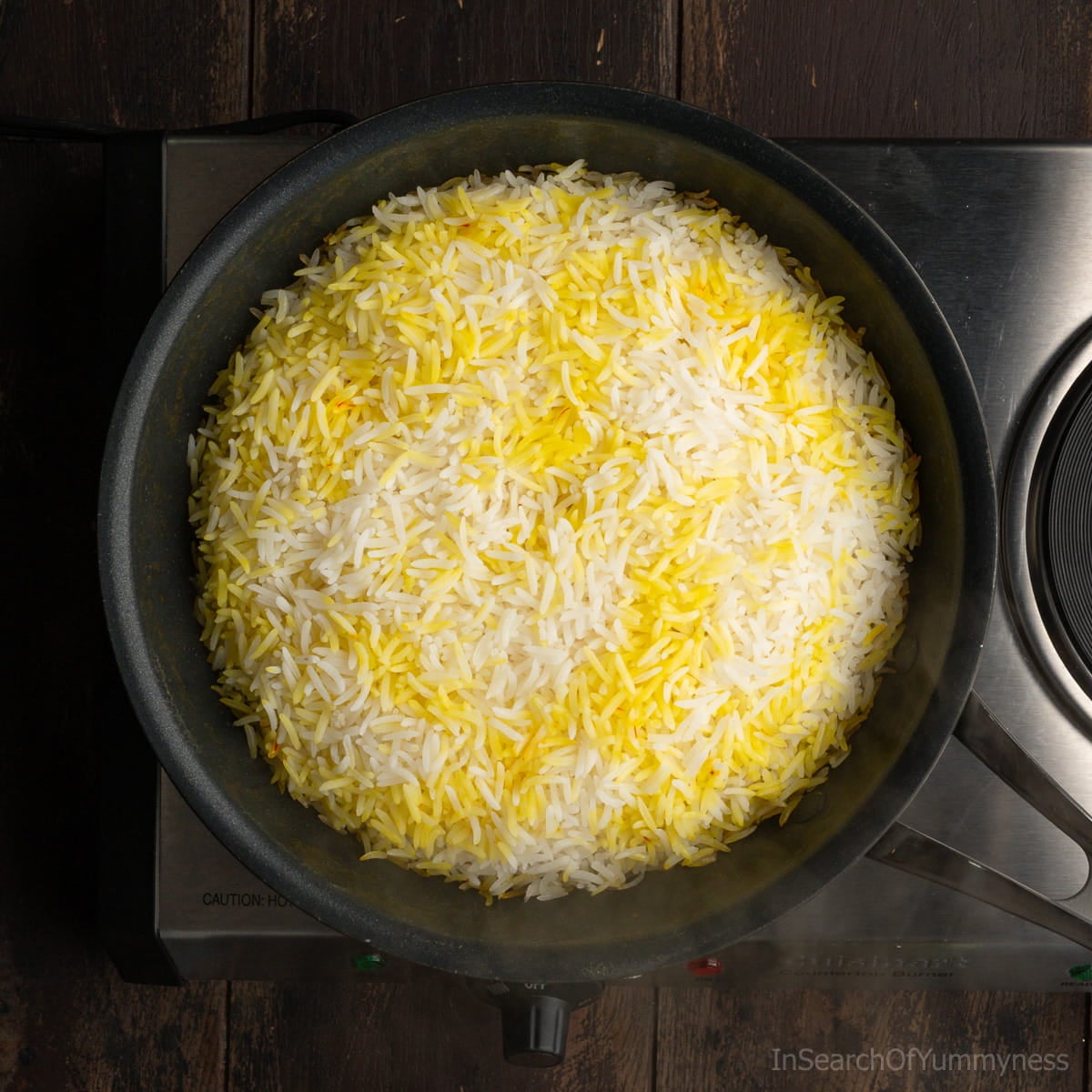
Step 8: Lift the lid to check that the potatoes aren't burning, then cook for about 10 more minutes. The tahdig is ready when the potatoes are cooked through and crispy, and the rice on top is cooked. Flip the cooked tahdig onto a plate. Mix the drained barberries with the remaining saffron water and spoon it over the rice.

It is VERY important to fold the towel up and secure it well away from the stovetop burners, especially on a gas stove. Don't use paper towels on a gas stove, as they can easily ignite.
How to Invert the Tahdig Onto a Plate
Take the pan off the heat and remove the lid.
Let it cool briefly, then cover the pan with a large plate or serving platter and flip it over confidently. In my experience, if you hesitate while flipping, it almost never turns out right.
Also, do this on your counter, never over the stove!
If your potato tahdig doesn't come out as a nice, solid rice cake, don't worry. Use a spoon to push the rice into a mound, and arrange the potatoes on top. It will still taste delicious.
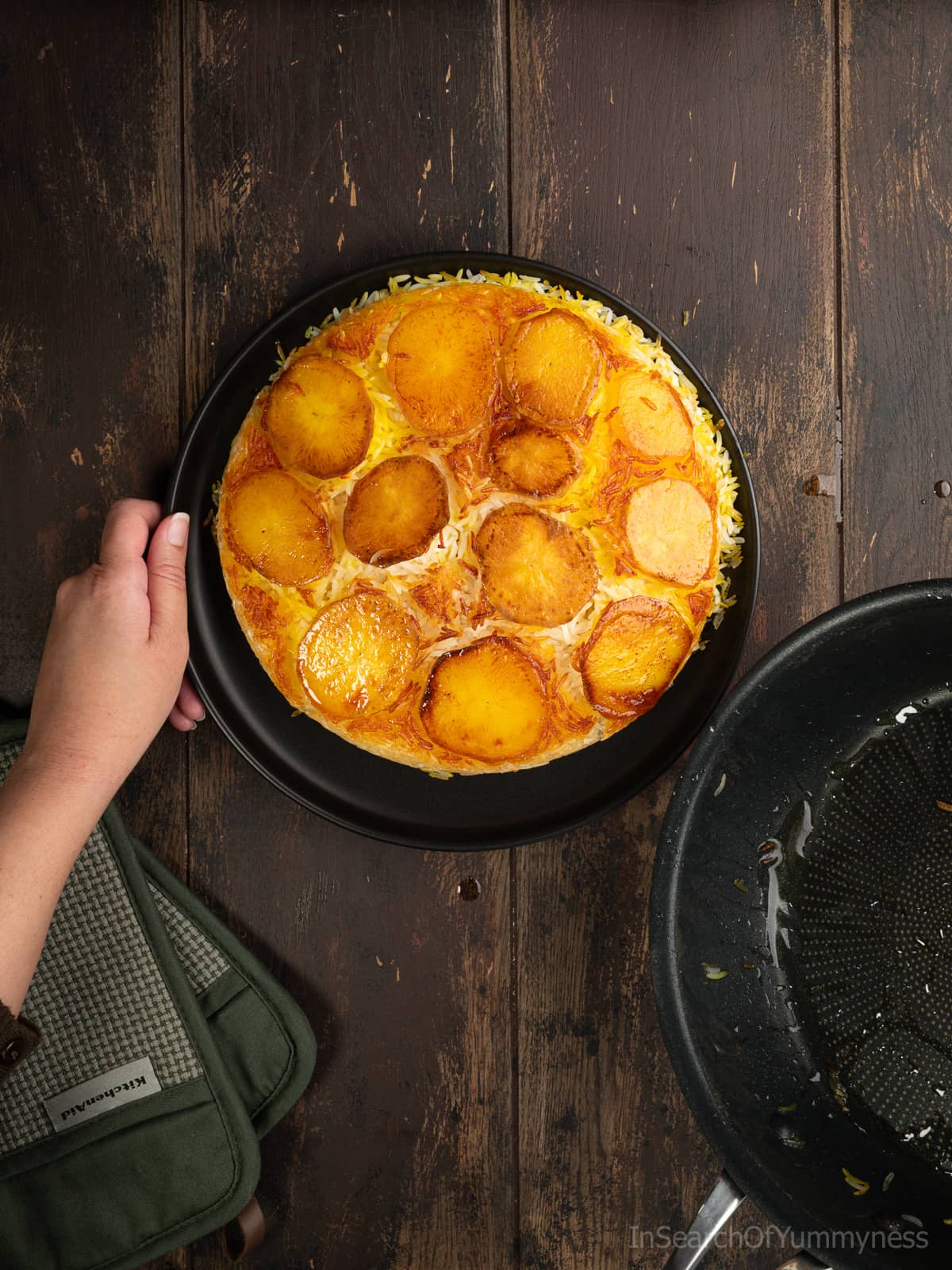
Flipping over the pan can be tricky, especially if you don't have a non-stick pan with two handles.
I used a non-stick frying pan with deep sides, but since it only has one handle, I have to let it cool down quite a bit so I don't burn myself when I invert it. You can find the exact pan here (affiliate link).
If you can, look for a deep non-stick pan with stay-cool handles (affiliate link) so you can hold the handles on each side against the plate and easily flip them both over.
Tips for Success
- Don't fully cook the rice in the boiling water. The grains should still be hard in the middle.
- If you have a mortar and pestle, use it to crush your saffron. It gives a finer texture than using the back of a table knife and parchment.
- Don't cut the potatoes too thin or they won't have the right texture.
- Make sure your potatoes are totally dry before adding them to the pan.
- Use a non-stick pan so the tahdig releases easily when you flip it.
- Always keep your towel or paper towels well away from the stovetop burners.
Storage Tips
Potato tahdig is best enjoyed fresh, when the potatoes are at their crispiest. Leftover potatoes will become soft, but you can still enjoy this dish the next day.
If you have leftovers, store them in an airtight container in the refrigerator within two hours of cooking. They should keep for up to 4 days.
When you reheat the rice, make sure it's piping hot throughout before serving. You can reheat the tahdig rice in the microwave, but I like to pull off the potatoes and reheat them in an air fryer to crisp them up a bit.

Serve With
This rice pairs well with stews (like fesenjan) or grilled meat, but these days we usually eat it with beef kebabs.
Swiss Chalet chicken will always have a special place in my heart, though.
Common Questions
Tahdig is a Farsi word meaning "bottom of the pot." It refers to the golden, crispy layer of rice, potatoes or flatbread that forms at the bottom of the pot, depending on the version you make.
The towel absorbs excess moisture as the rice steams, which helps keep the potatoes crispy. Without it, condensation collects and can make the potatoes soggy.
Yes, although I haven't had much success with this myself. You'll need to lift the lid every 5 minutes and quickly wipe the condensation off the lid with a towel or paper towel. If the lid stays off too long, you will lose the steam that cooks the rice.
Your heat may have been too high at the beginning. Try a slightly lower temperature next time.
Your heat may have been too low at the beginning. Try a slightly higher temperature next time.
More Side Dish Recipes You'll Love
- Couscous Salad with Chickpeas and Turmeric
- Greek Salad (without lettuce)
- Pesto Pasta Salad with Feta
If you love rice dishes, you'll probably enjoy my chicken pelau recipe too!
About Shareba
Shareba Abdul is a Trinidadian-Canadian recipe developer and food photographer with a Culinary Arts certificate from George Brown College and 15+ years of experience creating and testing recipes for home cooks. She is an active member of the International Association for Culinary Professionals and tests every recipe on this website in her own kitchen. Learn more →
Recipe Card
Potato Tahdig
Ingredients
- 2 cups basmati rice
- 4 teaspoons salt, plus extra for seasoning (see note)
- 1 pinch saffron threads, optional
- 3 tablespoons hot water, for the saffron and barberries
- 3 yellow potatoes, or gold potatoes
- 3 tablespoons salted butter
- 1 tablespoon grapeseed oil, or other neutral oil with a high smoke point
- 2 tablespoons dried barberries, optional
Equipment
- 2 Small Bowls, 1 for the barberries and 1 for the saffron
- Parchment Paper, for grinding saffron
- Table Knife, for grinding saffron
- 8-inch Frying Pan, with deep sides and a tight-fitting lid (or a saucepan)
- Kitchen Towel, clean
- Large Bowl, for washing rice
- Large Pot, for parboiling rice
Instructions
- If using barberries, place them in a small heat-proof bowl and cover with hot water. Leave them to soak.
- If using saffron, tear a small piece of parchment paper and place the dry saffron thread in the center. Fold the paper in half over the saffron, then fold the sides in so the saffron can't fall out. Place the parchment packet on a hard, sturdy surface (like a cutting board), then use the back of a table knife to firmly tap on the threads to crush them. Place the crushed threads into a small bowl and stir in 3 tablespoons of hot water. Leave to steep.
- Place the rice in a large bowl and cover with cold water. Swirl gently, drain, and repeat 4-5 times until the water runs clear. Soak the rice in cold water for 15 minutes, then drain.
- Peel the potatoes and slice them into ¼-inch (6mm) rounds. Place them in a bowl of cold water to soak while you cook the rice.
- Bring a large pot of water to a boil over high heat. Add 4 teaspoons of salt and stir until it dissolves. Add the rice and boil for 5 minutes. Pinch a grain between your fingers; the outside should be soft, and the middle should still be firm. Drain the rice in a strainer, rinse with cold water to stop the cooking, and drain well.
- Drain the potatoes, rinse with cold water, and drain again. Pat them completely dry with a clean kitchen towel or paper towels.
- In the non-stick frying pan, heat the oil and 1 tablespoon of butter over medium heat. As soon as the butter melts, add 1 tablespoon of the saffron water (be careful; it may sputter).
- Arrange the potatoes in a single, flat layer in the pan and lightly season with salt. Spoon a thin, even layer of rice over the potatoes and press down firmly to help form the crust. Add the remaining rice and press gently so it won't stick to the lid.
- If using, drizzle 1 tablespoon of saffron water over the rice (or the remaining 2 tablespoons if you're not using the barberries). Poke 5 shallow holes in the rice and tuck a pat of the remaining 2 tablespoons of butter into each one. Smooth the top to cover the holes.
- Wrap the pan lid with a towel and place it tightly over the pan. Fold the edges up over the lid and tuck them into the handle so no fabric hangs near the burner.
- Cook over medium heat for 5 minutes, then reduce the heat to medium-low and cook for about 30 minutes. The potatoes should be crisp on the bottom and cooked through, and the rice on top should be fluffy and tender.
- Remove the pan from the heat and take off the lid and towel. Let it cool enough to handle, then move the pan to your counter. Cover the pot with a large plate, hold the two together, and flip in one confident motion.
- Drain the barberries (if using) and stir them into the remaining 1 tablespoon of saffron water. Spoon them over the rice and serve immediately while the potatoes are still crispy.
- Refrigerate leftovers in an airtight container within 2 hours of cooking. They will keep for up to 4 days. Reheat until piping hot before serving.
Notes
- 4 teaspoons of salt seems like a lot, but the rice is only in the water briefly, so you need that much to season the rice. Don't worry, it doesn't absorb it all. I used sea salt; use less if using iodized salt.
- Yukon Gold potatoes work well in this recipe, but they are hard to find these days. Any yellow or gold potato should work, or you can use Russets.
- Make sure the potatoes are totally dry before adding them to the pan to avoid sputtering and ensure a crispy bottom.
- I used an 8-inch non-stick frying pan with deep sides, but a two-handled non-stick pan would be much easier to flip.
- Keep the towel folded up and secured well away from the burners, especially if you have a gas burner. Don't substitute paper towels if you have a gas burner. To do this without a towel, lift the lid and quickly wipe it every 5 minutes to remove the condensation that builds up.
- Always flip your tahdig on your counter, not over your stove.
- If the tahdig breaks when you flip it, push the rice into a mound with a spoon and arrange the potatoes on top. It will still taste delicious.
- Refrigerate leftovers within 2 hours, and store them for no more than 4 days. Reheat the rice until piping hot before serving. I like to pull the potatoes off and reheat them in my air fryer to crisp them up a bit.
Please read the full blog post for all of my tips, variations, and recommendations for this recipe.
Nutrition
Nutritional information is an estimate provided as a courtesy and will vary based on the specific ingredients used. For exact values, use your preferred nutritional calculator with the products you're using.
Private Notes
Have you made this recipe?
Let us know how it turned out in the comments!About Shareba
Shareba Abdul is a Trinidadian-Canadian recipe developer and food photographer with a Culinary Arts certificate from George Brown College and 15+ years of experience creating and testing recipes for home cooks. She is an active member of the International Association for Culinary Professionals and tests every recipe on this website in her own kitchen. Learn more →


Sinead Thomas says
I made this tonight and it’s really wonderful thanks for the recipe. Had this years ago and always remember how wonderful it is. I have a two year old who loves just rice and potatoes so this was perfect for her x
Shareba says
I'm glad that you and your daughter enjoyed the recipe Sinead! 🙂
Gwion Raven says
Lovely version of this dish. Quick, pretty simple, and VERY delicious.
I posted it on my FB page and IG - The Magick of Food.
Gwion Raven
Author of "The Magick of Food: Rituals, Offerings, & Why We Eat Together"
Shareba says
Thanks for sharing my link and taking the time to leave a comment Gwion 🙂
Fardin says
I read your recipe and i liked it as an iranian guy. Anyway I prefer using sort of iranian traditional rice for cooking.
I also recommend you to look for the recipe of "tahchin" or chicken tahchin, another persian food, and try it too.
Good luck.
Shareba says
Thanks for your comment Fardin, I'm glad you like it. I will ask my Iranian friends if they can tell me about tahchin!
Laura says
In our house, we call it Massimo rice after an Iranian friend who took the name Massimo when he attended university in Italy.
It has been years since I made it, but had a request. Thanks so much for the refresher.
Shareba says
That's such a nice story Laura. I'm glad you found the recipe helpful!
Douglas Hogan says
I am about to make the potato tadig, but this time with brown rice. I had learned to make this years ago from a native Iranian, whom I shared an apt with in St. John’s, NL, Canada. I have always weighed down the lid with a brick or rock ( whichever was handy). I am making it for my mother to try.
I have always enjoyed this dish with yoghurt. I will let you know how it comes out.
Douglas Hogan
Shareba says
Hi Douglas, thanks for sharing the tip about weighing down the lid! I'll have to try that. Definitely let me know how it turns out with the brown rice too!
Sean@Diversivore says
Potatoes on rice. Carbs on carbs. Yes on please. This looks wonderful. It's so easy to fall into the same habits with rice, and this reminds me that I really need to explore Persian cooking more. I had a colleague during my graduate degree who always brought in simple but memorable rice dishes like this (always loaded with those dried barberries too). That rice still stands out in my mind. Glad to see all the little tips and pointers too - I had no idea there could be so many ways to go wrong in a rice dish like this! But as they say, forewarned is forearmed. So thanks, and kudos!
Shareba says
There are so many variations of this dish that you can try out! I want to make the flatbread version next, but this potato tahdig version will always be my favourite. I'm glad you found this post useful Sean!
Fouzia Husainy says
I love the use of saffron in cooking whether it is for sweet or savoury dishes. Saffron rice is one of my favourite dishes. You can just eat it on its own as it is so flavourful. Yours looks so beautiful and colourful with the nicely browned potatoes and barberries. Delicious!
Shareba says
Thanks Fouzia! I agree, saffron rice on its own is delicious!
Nicoletta @sugarlovespices says
This dish looks beautiful! A lot of preparation but the result is amazing! Never had anything like that, but I'd love it. I know the saffron adds a delightful touch.
Shareba says
It is a lot of work, but it's so worth it!