

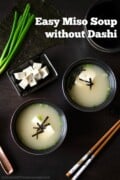
Miso soup is traditionally made with dashi stock. If you don't have dashi and can't make your own, try this miso soup recipe without dashi.
This soup is a quick, comforting way to enjoy a warm bowl of miso soup, using mushroom, vegetable, or seafood stock. You can make this easy recipe in about 15 minutes.

Recipe Highlights
- Servings: Makes about 6 servings
- Time Commitment: 15 minutes (5 minutes of preparation and 10 minutes of cooking)
- Effort Required: Easy
- Dietary Notes: Vegetarian when made with vegetable or mushroom stock
Jump to:
What is Miso Soup?
Miso soup is a Japanese soup made by dissolving miso paste, a fermented soybean paste, into hot soup stock.
Traditionally, that stock is dashi, a soup stock made with kombu (dried kelp) and sometimes katsuobushi (dried bonito flakes).
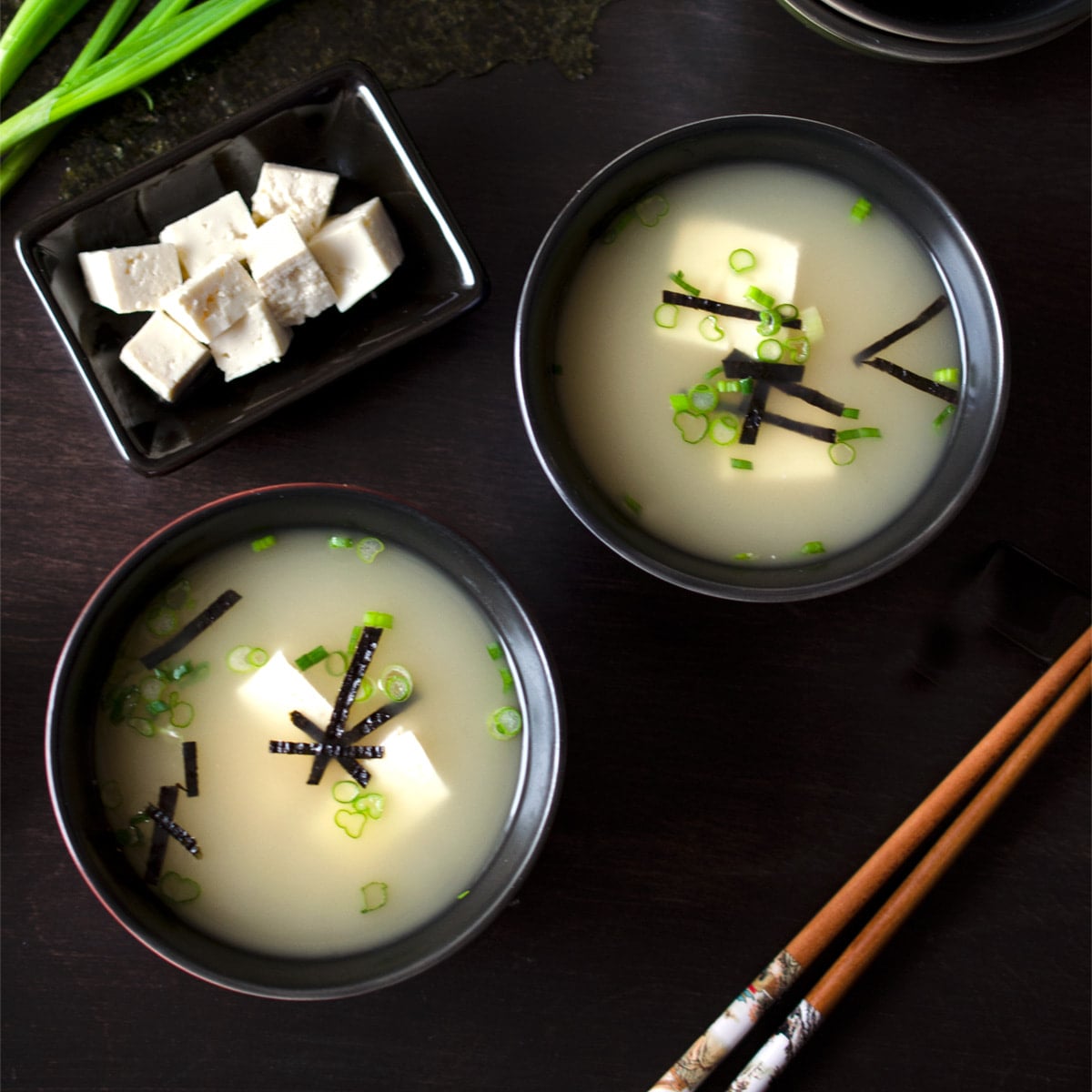
The soup often includes green onions, seaweed, and tofu.
I want to be upfront: this isn't a traditional miso soup recipe. I developed it so you can enjoy a miso-based soup at home when you can't find or make dashi.
If you would like to try a traditional version, Just One Cookbook (an established food blog) has a detailed guide on making authentic homemade miso soup.

Ingredients and Substitutions
This miso soup without dashi uses only a few ingredients, so the stock and miso paste you choose will strongly affect the flavour.
- Stock: Mushroom, vegetable or seafood stock all work well here. I recommend ready-to-use stock sold in cartons over dried stock cubes or powdered stock, since they can be very salty and the miso paste will add salt to the soup.
- White Miso Paste: This miso paste is mild and slightly sweet, and is the easiest miso to find where I live. Look for miso sold in the refrigerated sections of large grocery stores or Asian food markets.
- Tofu: I like the texture of medium tofu in this soup, but soft or silken tofu also works. Tofu is easy to find at most large grocery stores these days.
- Green Onion: Thinly sliced green onions add a mild onion flavour.
- Seaweed: I often use roasted seaweed (nori) because I buy it in bulk for snacking, but dried wakame seaweed is the traditional seaweed used in miso soup. Wakame has a silky, slightly chewy texture. Nori is very thin and should be added just before eating.
This recipe has not been tested with all possible substitutions or variations. Making changes may alter the taste, texture or overall outcome. If you try a different ingredient, please share in the comments!

See the recipe card for the complete ingredient list and recipe instructions.
Variations
- Seafood Stock: The oceanic flavours of seafood stock echo the flavour you'd get from kombu in dashi stock.
- Mushroom Stock: Adds an earthy depth of flavour that pairs nicely with the earthy notes in miso paste.
- Vegetable Stock: A neutral option, although some vegetable stocks can have a strong carrot flavour.
- Chicken Stock: While this doesn't taste like traditional miso soup, it makes a tasty miso chicken soup.
- Dried Wakame: Rehydrate it according to the package directions before using.
- Instant Dashi Powder (Hondashi): For a flavour closer to a restaurant-style bowl, use instant dashi powder. Use about 1 teaspoon of granules per 2 cups of water, or follow the package directions. Note that this usually contains bonito (dried fish).

Why I Make This Recipe
Miso soup is one of my favourite dishes to order when I go out for Japanese food, because it's delicious and comforting.
When I first wrote this recipe, instant dashi wasn't available where I lived, so I started testing miso soup with other stocks.
While this isn't an authentic or traditional recipe, it is a nice way to enjoy miso soup flavours with what you have at home.
If you're in the mood for more comfort food recipes, you'll find more ideas in my collection of soup and stew recipes.

How to Make Miso Soup Without Dashi
This miso soup recipe comes together quickly. Heat the stock, add the miso paste and whisk to dissolve, then add the tofu and green onions. Garnish with the seaweed right before serving.
Tips for Success
- Choose a carton of stock over dried stock cubes for a less salty soup.
- If using roasted seaweed (nori) as a garnish, add it right before serving for best texture.
- Never boil miso soup. Boiling it can make the soup lose flavour, and in my experience, it makes the texture gritty. Remove the pot from the heat before adding the miso to be safe.
How to Store
Allow the soup to cool (no more than 2 hours at room temperature for food safety). Store leftover soup in an airtight container in the refrigerator for up to 2 days. Reheat gently over low heat, but don't let it boil.
Don't freeze the soup with the tofu, as the tofu can become spongy or crumbly.
More Soup Recipes You'll Love
Recipe Card
Miso Soup without Dashi
Ingredients
- 6 cups mushroom stock or broth, or seafood stock, or vegetable stock
- ¼ cup white miso paste, plus extra to taste
- ⅔ cup medium-firm tofu, or silken tofu, cut into small squares
- 1 green onion, thinly sliced
- 1 sheet roasted seaweed (nori), cut or torn into small pieces (optional)
Equipment
- Medium Soup Pot, or Saucepan
- Ladel
Instructions
- Place the soup pot over medium heat and add the stock or broth. Heat until just warmed through (don't boil it), then remove from the stovetop.
- Add the miso paste to the warm stock and gently whisk until fully dissolved. Taste the broth. If it needs more flavour, add more miso one tablespoon at a time.
- Add tofu and green onions, and stir gently.
- Ladle the soup into bowls and garnish with roasted seaweed, if using. Serve immediately.
Want More Recipes Like This One?
(You can easily unsubscribe at any time)
Notes
- Use carton stock or broth instead of dried stock cubes or powdered stock to avoid making the soup too salty.
- You can use instant dashi powder instead of stock. Use 1 teaspoon of granules per 2 cups of water, or follow the package directions.
- Chicken stock makes a tasty soup, but it doesn't taste anything like traditional miso soup.
- Replace medium-firm tofu with soft or silken tofu, if desired.
- Replace nori with wakame seaweed (which is traditional) if desired. Follow the package instructions for rehydrating the wakame before using.
- Do not leave this soup at room temperature for more than 2 hours. Refrigerate leftovers for up to 2 days.
Please read the full blog post for all of my tips, variations, and recommendations for this recipe.
Nutrition
Nutritional information is an estimate provided as a courtesy and will vary based on the specific ingredients used. For exact values, use your preferred nutritional calculator with the products you're using.




Jill says
I’m anxiously awaiting amazon so I can make this as I couldn’t find miso . I know I will love it .
Shareba says
I hope you enjoy the recipe when you get to make it!
Iris says
Funny thing, I thought a post with “recepie” in the title would start with the recepie?
Instead a bunch of pages later, and —-way too many adds—- (annoying and guarantees that I won’t be back), I finally find the recepie. Sounds a bit bland, and I never did confirm wether or not it contains carrots. Yes, I know chicken or vegetable stock “may” contain carrots, unfortunately nearly all of them do.
Shareba says
Hi Iris, thank you for your feedback.
First, no, the recipe itself does not contain carrots. You can use fish stock, vegetable stock, or mushroom stock for this recipe, as it says in the recipe instructions. So if you're unable to have carrots, you can easily select a stock that does not contain carrots.
Secondly, sure, I could just stick the recipe at the top of the page with no photos or instructions, but frankly if that's what you prefer, you should go to a website like allrecipes. Or buy a cookbook.
Food blogs are meant to share stories or tips, so yes they are long but that's kind of the point.
As the ads, this may come as a surprise to you, but it actually takes me time, effort and groceries to create content for this website. It costs me money to create FREE content for people to enjoy. The ads bring me a small amount of money that helps to cover those expenses.
So yes, the ads are annoying but if you aren't willing to scroll for a few seconds to reach content that is available to you for FREE, then my website simply isn't for you. Have a great day!
Jill says
In this world we live in do you not have anything else to do or is it your career to make rude comments instead of passing by ! Obviously it was interesting to you .
I think although this is very old you should be ashamed & apologize .
kwiklip says
What's wrong with MSG? Unless you have a particular sensitivity to it, it's not harmful.
Shareba says
There's technically nothing wrong with it, and I understand that it's generally considered safe. However, as many people do have adverse reactions to it, and it's literally one of the two main ingredients in Hondashi and I was focusing on a healthy version of this soup, I opted not to use it in this dish.
Sean@Diversivore says
I must say, as a die-hard scratch-dashi fan, I wonder what went wrong myself. The briny, seaweedy taste of good dashi can be a little unfamiliar for sure, but I've never had a batch turn out so... well, fish-tank-y. I wonder if it was the kombu itself? I use a slightly different method for my kombu - I soak the kombu in cold water for a little while, then heat the water and remove the kombu immediately before it boils. Then I add my katsuobushi and let it sit for only a few minutes (I find the smell of katsuobushi MUCH stronger than the taste of the end product, but I do know what you mean). I do know that boiled kombu can become quite bitter, but it doesn't sound like you did that here. In any case, I applaud your efforts, and I hope future attempts go a little more swimmingly (no fish tank pun intended). You've done a great job of putting together a good miso soup here regardless, and I think your tips are pretty useful. And honestly, I bet it's a far site better (and healthier) than the average miso soup made from a packet!
Shareba says
Ahahaha, swimmingly! Thanks for your feedback on the post Sean. I really have no idea where I went wrong. The liquid was so funky and off-putting, I could barely put it in my mouth! It wasn't bitter, but like... dirty tasting? It could have been the kombu... I bought it online because I couldn't find it in store. I followed the directions to make dashi from the package, but just didn't leave it for the full 8 hours. Total failure. I may try again in future if someone can recommend a good brand of kombu.
Amanda says
I hope you are feeling better soon and get good rest results back! Miao soup is always a treat but I have yet to venture into making it. When I finally get the guys, I will be pulling-up this post! I am glad you noted not to use chicken stock as I soooo would have!
Shareba says
Thanks Amanda! I'm hoping for good test results too. Thanks for reading my post! And no problem about the chicken stock - I didn't realize it wouldn't work until I tried it!
Paula says
Dashi is a pain to make! I've been there. The end result looks yummy tho!
Shareba says
I was so frustrated that I couldn't get it to work! I looked up several recipes and couldn't figure out where I went wrong. The end result was tasty though 🙂 Thanks for stopping by!